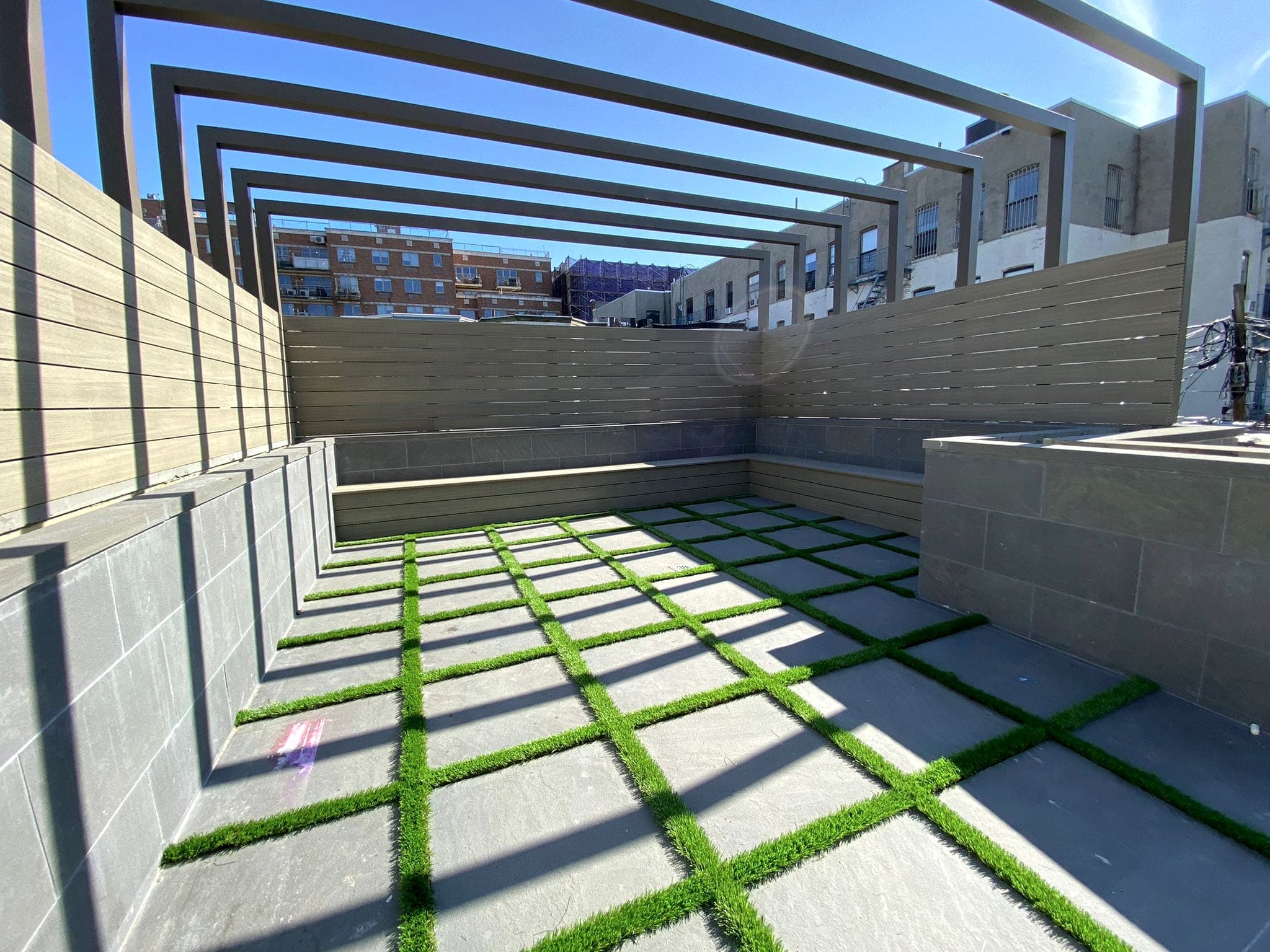
A real NYC rooftop deck in 2026 runs $80–$220 per square foot installed. The wide range is honest — the cost drivers are unevenly distributed, and most online numbers either over- or under-state by 50%. This guide breaks down what actually goes into the budget, where bids hide cost, and how to read a proposal.
The short answer
For a typical NYC rooftop deck — 600 to 1,000 square feet, IPE or porcelain pavers, basic planters, lighting, and a simple pergola — expect $80,000 to $180,000 installed. The median project lands around $130 per square foot, or roughly $80K for a 600 sf terrace. Higher-end builds with louvered roofs, outdoor kitchens, and mature planting climb to $200–$300/sf and total $200K–$500K+.
What the budget actually buys
A rough breakdown of a $130/sf NYC rooftop deck looks like this:
- Deck surface ($30–60/sf): IPE 1×6 on hidden fasteners, or 2cm porcelain pavers on adjustable pedestals. Pedestals add cost but keep the membrane accessible.
- Membrane protection & drainage ($10–20/sf): Slip sheet, drain access detail, overflow paths. Boring. Critical. Most failures start here.
- Planters & built-in beds ($8–25/sf): Custom steel, fiberglass, or wood-clad. Lightweight soil mix. Subirrigation if the planter is big.
- Pergola or shade ($5–40/sf): Cedar pergola is the budget option; powder-coated steel or aluminum louvered roof is the upper end.
- Lighting & irrigation ($8–18/sf): Low-voltage runs, smart controller, drip and micro-spray. Always more work than people expect.
- Soft furnishings (not included): Outdoor sectionals, dining sets, planters of plants themselves usually live on the client's side of the budget.
- Permits, filings & engineering ($5K–$25K): When structural reinforcement, gas, or electrical work is involved. P.E. or R.A. fees, expediter, DOB filing.
- Building access & logistics ($5–15/sf): Elevator reservations, building protection, after-hours work, sometimes a hoist. Adds up fast on tall buildings.
The five things that drive cost up
1. Structural reinforcement. If the existing roof can't take the live and dead load of the planned design, the math doesn't work. Either the design lightens, or the structure adds steel. Reinforcement adds $40–$120/sf to whatever the deck would have cost. The first move on any rooftop is a load study with your building's engineer; we'd rather redesign than overbuild.
2. The deck material. IPE remains the gold standard ($45–65/sf installed on a roof). Porcelain pavers on pedestals are close ($35–55/sf) and lower maintenance. Composite is usually the wrong choice on a rooftop — heat gain and movement cause problems. Cedar is rarely used on roofs anymore; lifespan is too short.
3. Pergola, louvered roof, or substantial shade structure. A simple cedar pergola adds $8K–$15K. A powder-coated steel pergola, $20K–$40K. A louvered aluminum roof system (Struxure, Stratco, Equinox), $25K–$70K. The louvered systems are the move if the rooftop sees real summer sun; they pay back fast in usable hours.
4. Outdoor kitchen. A built-in grill, refrigeration, prep counter, sink, and the gas and electric to support them: $35K–$120K. Rooftop kitchens add structural and utility complexity over backyard kitchens. Worth budgeting for properly.
5. Access and logistics. A 30-story building with one freight elevator and a two-hour daily reservation window costs significantly more to build on than a brownstone with rear-yard access. Tall buildings, hoists, after-hours rules, and building protection add 10–25% to a comparable project.
Where cheap bids hide cost
The hardest part of comparing rooftop deck bids is that they look similar on paper. Two bids of $95K for a 700 sf deck can be 60% apart in actual scope. Common places where the cheaper one is cutting:
- Pedestals omitted. Pavers laid directly on the membrane. Saves money on day one; makes the next roof inspection a demolition project.
- Membrane slip sheet omitted. Felt or geotextile under the deck system. Cheap insurance. Sometimes left out.
- Undersized electrical and gas runs. Sized exactly for what's installed today, with no headroom for the heater or kitchen you'll add in year three.
- Planters too light for the load. Wind-tested or not. Lightweight planters lift; we've seen them go over a parapet.
- Engineering not included. "Pending P.E. review" in the bid often means $10K–$20K of fees the client absorbs later.
- Access and logistics buried. "T&M, not included" for elevator reservations, building protection, after-hours hoisting. Most of those costs are real and forecastable.
How to read a proposal
A good rooftop deck proposal has these things: full quantities (square footage of decking, linear feet of planter, number and type of fixtures), unit pricing on the major items, a clear scope of what’s included and excluded, the structural strategy, and a schedule that accounts for building access. If the bid is one page and a lump-sum number, you don’t have enough to compare.
We share line-item proposals on every project. Per-square-foot pricing for hardscape, per-foot for planters, per-fixture for lighting. Two rounds of revisions in the design phase are normal; the budget locks in once design is signed off.
Common questions
- What's the average cost of a rooftop deck in NYC?
- In 2026, a fully built NYC rooftop deck typically runs $80–$220 per square foot installed, including hardscape, structural prep, basic planters, and lighting. The median project lands around $130/sf. A 600 sf terrace usually falls in the $80K–$140K range.
- What drives the cost up?
- Five things, in roughly this order: structural prep (if the existing roof needs reinforcement), the deck material (IPE vs. composite vs. porcelain), pergola or shade structure, outdoor kitchen, and access logistics (elevator restrictions add labor cost). Substantial planting and irrigation add another 10–20%.
- Where do cheap bids cut corners?
- Usually under the deck. Skimped membrane protection. Pavers laid directly on the roof rather than on pedestals. Skinny gas and electrical runs that can't handle future additions. Planters sized for the visual, not the load. The deck looks fine on day one; the problems show up at year five.
- Are there permit costs?
- If structural reinforcement, gas, electrical, or substantial mechanical work is involved, yes — DOB filing fees, expediter, P.E. or R.A. fees usually total $5K–$25K depending on scope. Cosmetic-only refresh of an existing deck often doesn't need a filing.