Brownstone backyards,
shaped around four hours of sun.
MintScapes designs and builds rear-yard outdoor living for brownstones and townhouses across Brooklyn and Manhattan. Privacy walls, hardscape, planting, dining and entertaining — the space between your back door and the property line, made into a room you actually use.
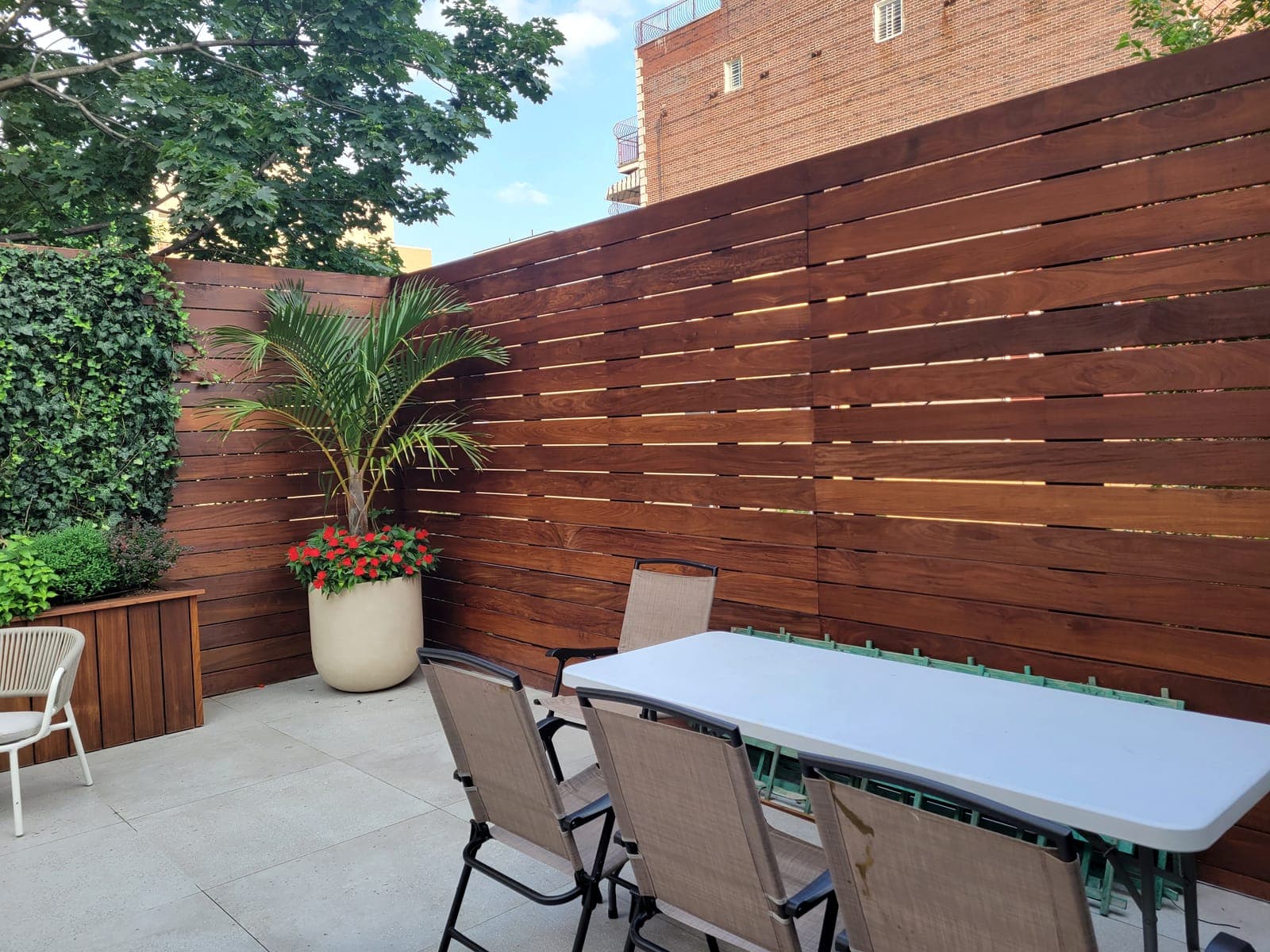
A brownstone yard is a 20- to 30-foot-wide rectangle bordered on three sides by other people’s buildings. The light is short, the privacy is partial, the soil is usually exhausted, and yet this is the most-used outdoor space in NYC — morning coffee, weekend dinners, kids underfoot, the dog. A good design respects all of that.
Most of our backyards land between 600 and 1,200 square feet. Typical scope: bluestone or porcelain pavers underfoot, IPE or cedar privacy walls on the long sides, built-in beds along the perimeter, a dining area scaled to the family, and a planting plan that survives the light the yard actually gets. Budget ranges from around $50K for a clean refresh of an existing hardscape to $180K+ for a full redesign with built-in seating, an outdoor kitchen, and mature trees.
The pieces of a usable yard.
Not every yard needs all of these. We’ll tell you what yours actually needs at the walk-through.
Hardscape
Bluestone, porcelain pavers, brick, or a hybrid. Set on a proper base with drainage so it stays flat through winters.
Privacy walls
Horizontal IPE, cedar slats, planted screens, or a hybrid. The single biggest move toward a yard that feels enclosed.
Built-in beds
Stone, steel, or wood-clad. Sized to the planting plan. Subirrigated where it earns its keep.
Lighting
Path, accent, and silhouette. Low-voltage runs hidden in the hardscape, controlled by zones.
Irrigation
Drip for beds, micro-spray where needed. Smart controllers tied to local weather.
Pergolas & shade
Cedar or IPE pergola, retractable shade, or a planted overhead. Often the single change that makes summer dinners possible.
Outdoor cooking
Built-in grill or freestanding setup, prep counter, sink, optional refrigeration. Scaled to the actual yard.
Drainage & grading
Cellar egress regrading, French drains, splash management. Boring, essential, gets it right the first time.
Map the light, then design the room.
Light study first. Before a single bed gets drawn, we map the sun pattern across the yard — winter and summer, morning and afternoon. Brownstones in Park Slope and Cobble Hill typically get three to five hours of direct sun in the rear yard. That number, not a plant catalog, decides the planting palette.
Privacy is a layout question, not just a fence.The most-used corner of any brownstone yard is the spot least visible from the neighbors’ upper floors. We site dining and lounging around sightlines, then add walls and planted screens where the layout alone doesn’t solve it.
The ground plane sets the tone.Bluestone reads classic and grounded; porcelain pavers read modern and stay cleaner; brick reads historical and weathers softly. We’ll show you all three at full size on the actual yard before you commit. Material samples and a 3D rendering of the proposed layout are part of the design phase.
Plants come last, on purpose.Hardscape, drainage, irrigation, and lighting are committed structural work — they need to be right the first time. Planting is the layer that can be tuned over the first two seasons. We design the structure to support the planting plan; we don’t let the planting plan get held hostage to a hardscape that doesn’t work.
What clients ask first.
- How much does a brownstone backyard cost?
- Most brownstone backyards run $50K–$180K all-in, depending on size, materials, and the work below grade. A typical 20'×40' Brooklyn rear yard with bluestone underfoot, IPE privacy walls, a small dining area, and built-in beds lands around $70K–$110K. Outdoor kitchens, retaining walls, mature trees, or a basement extension regrade push it higher.
- How long does a brownstone backyard take?
- Four to nine months from first walk-through to finished space. Design and material specs take six to eight weeks. Build itself is usually six to twelve weeks on-site. Landmarks districts add a few weeks if the rear elevation is touched.
- Do you handle Landmarks (LPC) approvals?
- For rear-yard work that doesn't touch the building or front elevation, LPC usually isn't involved. When it is — adding a deck, changing the rear facade, building a structure visible from a neighbor — we draft the package and walk it through with your architect or one we refer.
- What about the neighbors and the building above?
- Two real constraints. Most NYC rear yards get four hours of direct sun because of the building next door, which is the first thing we map. Privacy from upper-floor neighbors is the second — usually solved with horizontal IPE walls, planted screens, or a pergola with a louvered top. We design both into the layout, not around it.
- Can you work with existing plantings or trees?
- Yes, and we usually do. Mature trees and established perennial beds are valuable; ripping them out is rarely the right move. We work around what's there, prune for sun where it helps, and add to the palette rather than replacing it.
- Do we have to keep you on for maintenance?
- No. Year-one establishment is on us — that's part of the project. After that, most clients keep us on a seasonal plan (spring open, summer check, fall close), but plenty hand it off to their own gardener or take care of it themselves. We'll refer good care crews if you want one.
Related service
Outdoor kitchens →
A built-in grill in the rear yard changes how a brownstone family entertains.
Related service
Rooftop decks →
Many brownstones gain a second outdoor space above. Often pairs with a yard redesign.
Working in
Brooklyn →
Park Slope, Cobble Hill, Fort Greene, Clinton Hill, Carroll Gardens, Boerum Hill, and beyond.
Have a backyard in mind?
Send us the address.
Tell us the address and what you’re hoping for. We’ll come walk it. Most yards start with a 30-minute walk-through and a rough budget the same week.